The purest words. Ever

It was the richest, most avant-garde, secular country of the entire Middle East. One of the smallest nations of the world held the hearts of people from the region and beyond. Its cosmopolitan heyday lasted roughly from the mid-50s to 1975.

It was the emblem of liberalism, of how – at least on the surface – differences can unite a coexisting variegated population: Muslims Sunni and Muslim Shi’ite, Christians.
All together in that tiny land of mountains and Mediterranean Sea, that handkerchief on planet earth that was so unique it allowed you to go skiing in the morning and swimming in the afternoon. Everything seemed easy, reachable and possible in Lebanon, starting from happiness.

On the surface, it mattered little if it was France, the colonizing power up to 1943, who drew Lebanon’s borders, if starting from then the country was ruled by a sectarian elite, if factions of self-interest always prevailed ahead of state and nation and if the idea of a nation was still embryonic.

The intentions were good: at the founding of Lebanon, under the National Pact, it was agreed the President had to be a Christian Maronite, the Prime Minister a Sunni, the Speaker of Parliament a Shi’ite Muslim. The quota of democracy.

In 1952 Lebanese women gained the right to vote and, the year after, Parliament drafted one of the first anti-corruption laws of its kind. Lebanon was ahead.

Tourism boomed, both from the Arab World and from afar. The jet-set had chosen Beirut to holiday and be seen, jet-ski and indulge.
Brigitte Bardot, Peter O’ Toole, ElizabethTaylor and Richard Burton, Omar Shariff, King Farouk of Egypt were habitués of the iconic St. George’s Hotel; Casino du Liban hosted Miss Europe beauty pageant (1964) and was the stage where Duke Ellington and Jacques Brel performed.
Postcards from Lebanon made everyone dream.

Middle Eastern companies were transferring their headquarters to Lebanon, Beirut was the financial and trade centre of the entire region, its harbor known for hosting cruise liners (see the Queen Elizabeth II) while the American University was the debating society of the new thinkers.

That Mediterranean appeal with the Near Orient flare were the perfect alchemy. Yet, it was glamorous, but there was no national unity, still.

It was affluent, but not for everyone: poverty, out of Beirut, was spread. It was fashionable and avant-garde, but beneath the surface discontent was palpable, deriving from sectarian politics.

Lebanon – like no other country in the world – was continuing to bear the shockwave of the creation of the State of Israel (1948) which had sent 100,000 Palestinian refugees over the border.

It was a foretold catastrophe and it started in 1975.

The war, a prolonged agony, lasted up to 1990. Over fifteen years of numerous internal and external contenders, alliances and frequent reversals of alliances, of massacres. Endless. It became one of the most difficult conflicts to report and analyze, fought from building to building, door to door, window to window, breath to breath. It was the war of the neighbourhoods, streets, barricades and barrage of atrocities and explosive devices. It was the war that generated subconflicts, claimed the life of at least 120,000 people and swallowed 17,000 through forced disappearances.

It was chaos, with Syria dreaming to place Lebanon under the project of a ‘Greater Syria’ and Israel intending to oppose the PLO (Palestinian Liberation Front) militiamen creating a security zone under their control.

At the root, though, it was pain. Immeasurable pain, still felt today.

One night, I happened to watch some footage from the War of the Camps, a sub-conflict within the 1984–89 phase of the Lebanese civil war in which Palestinian refugee camps were besieged.
Of all the horror I swallowed, I could not refrain hiccups and tears when the images moved to a wounded child, on a ‘hospital’ bed.
There was nothing human in that scene.
A grown up was telling the young boy to be strong and resist.
The child asked how could he resist and the grownup replied “Pray, pray to God”
And so the boy did.
Laying in his trauma, his tattered bloodied clothes, the boy uttered:
“Dear God, protect my father. Dear God, protect my mother”.

Amid an ocean of obscenities, a tiny clean island.
Amid soul-corrupting hate and inhumanity, a quiet utterance of human soul.
This is surely a purity that should make all hearts, human and godly, weep.
The machines of hate are never silenced.
But one candle then, and many like it now, flicker their fragile human light against the blackest of blacks.
We can only trust and hope, that hope is never lost.

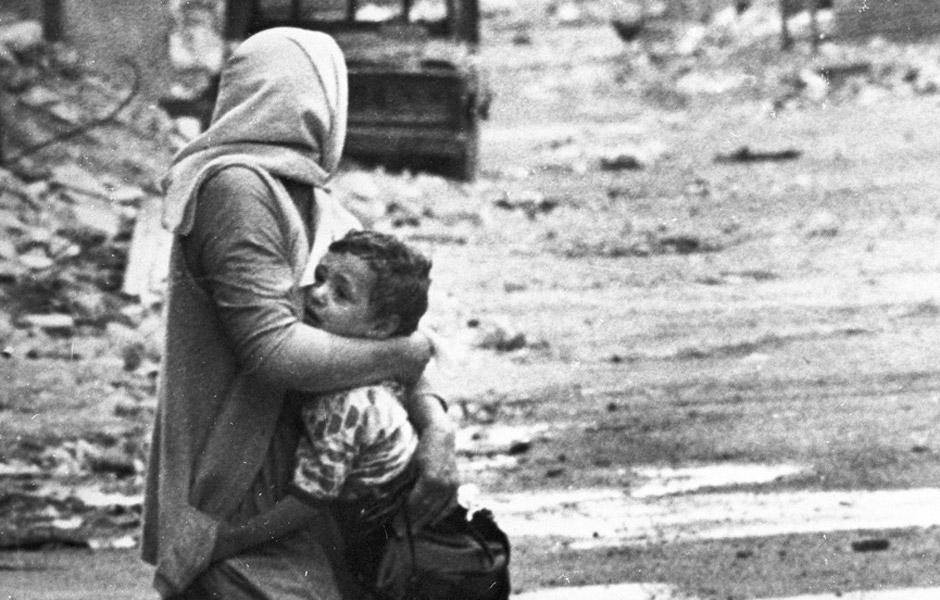
photo: A Palestinian refugee and her child caught in sniper fire during the War of Camps. Author: unknown
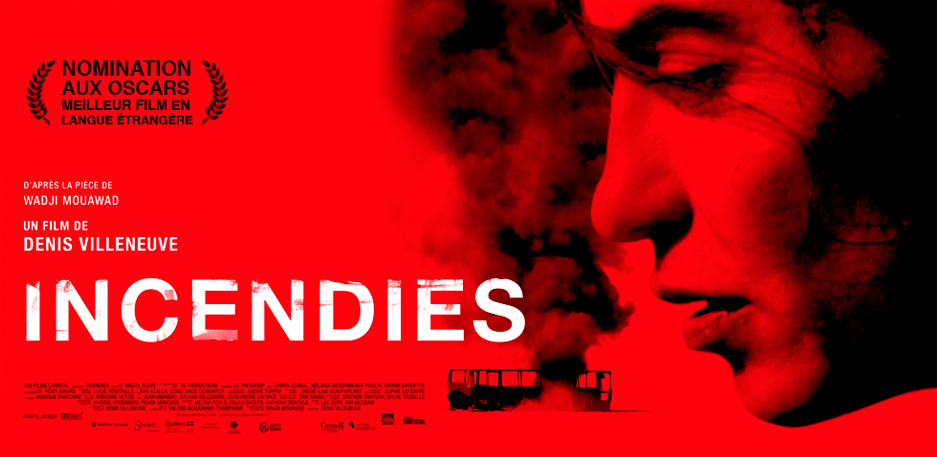
Incendies: relevant as ever

INCENDIES is a punch in the heart. It petrifies you as it speaks the language of any given war with the addendum, that additional element, that it is a sectarian war which turns into your blood system as a reminiscence of the Lebanese civil war (1975-1990, 150.000 lives lost).

It is one of the strongest films I have ever watched.

Simon and Jeanne are twins of Arab origin living in Canada where they must visit a notary to hear their mother’s will.
Out of the blue, they discover they have a brother and that their father is still alive.
To put things in order, deal with their mother’s last wishes and continue with their life, they have to travel to an unnamed Middle Eastern country that is recovering from years of sectarian war.
While painfully discovering their mother’s past, their future will never be the same.

Adapted from Wajdi Mouawad’s 2003 play (Mouawad fled Lebanon when he was eight), Incendies overflows with atrocities, yet it leaves an indelible impression as no one plays the victim: wars happen and we all act accordingly, whether with moral nobility or imbued with wickedness.

Directed by Denis Villeneuve – Canada, France, 2010, the film convinced me to say, again, that I highly dedicate the narrative to all those who dream of revolutions and of a fictionary ‘last war that will restore stability and world order’. Buffoons.

Notturno, the evanescence of borders

The borders between Syria, Lebanon, Iraq and Kurdistan in a film that took three years to shoot.

Borders are a sensitive matter, almost everywhere.
In the Middle East, Europe – at the fall of the Ottoman Empire, imposed new ones, often drawn arbitrarily, carelessly ignoring the region’s ethnic, religious, and linguistic diversity. Ignoring its past. Mining the future.
What followed have been incessant decades of wars and revolutions, coups and counter-coups, dictatorships, feeble monarchs, shaky republics and horrific ground for ISIS all-round fuckery.

Borders can be volatile and represent the difference between salvation and aggression, freedom and war, dreams and death. Borders contain the true victims of history: people trying to get by with their daily lives.
Borders are guarded by men in the middle of nowhere, at times defending God knows who by God knows what.

Italian director Gianfranco Rosi in his NOTTURNO filmed and followed the borders created by the Islamic state: borders which represent the divisions, the invisible stratifications that history has left. And the betrayal of humanity.

In a film where I constantly tested myself to understand where I was, trying to recognise the architecture or the fauna, the hijab and minarets, license plates and history through the walls, I was left in awe in front of the most sublime narrative painted through Rosi’s handheld video camera.

Notturno is a cinematic work of art that stabs your heart when Yazidi children recount their life under ISIS and yet never fails to show the impalpable beauty of the rest. And by ‘rest’ I mean everything else: human relations, traditions, nature and colours.

The film closes with the notes of Saja Al-Maghasba , Mawtini: والحـياةُ والنـجاةُ والهـناءُ والرجـاءُ (life, salvation, contentment and hope), enough to shed all of humanity’s tears.

I watched this masterpiece twice, and it does not leave me.

A piercing book: ‘What Have You Left Behind’ by Bushra Al Maqtari

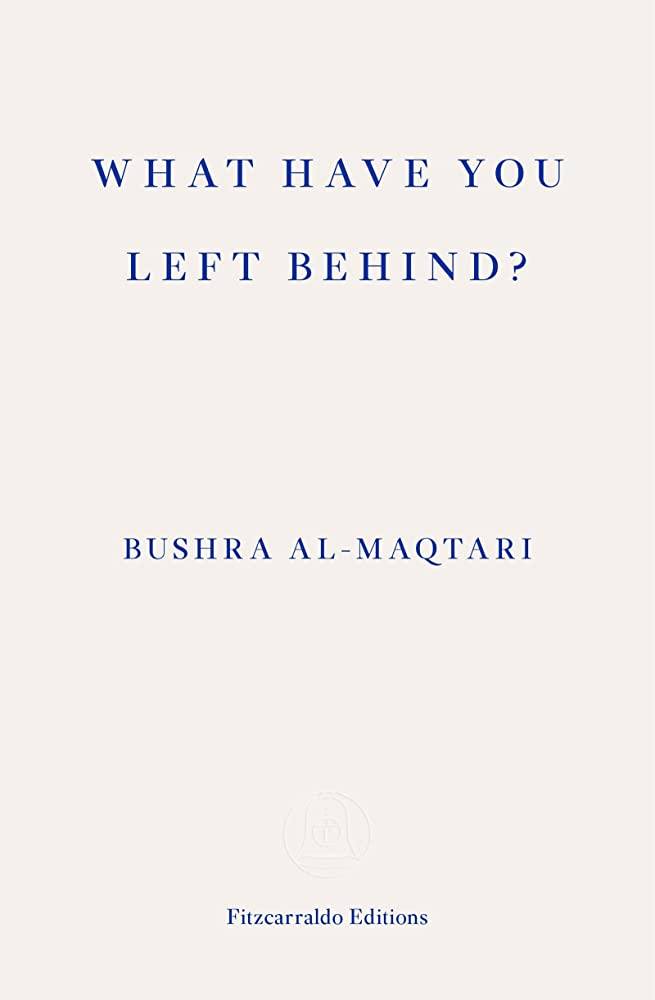
Most likely, there will never be a more perfect, dramatic, piercing book on the war in Yemen than What Have You Left Behind (Fitzcarraldo Editions) written by Yemeni researcher, writer, novelist Bushra Al Maqtari.

The introduction – painful yet without pity and hyperbolism – is a slap in the face: all the lies naively told in order not to accept that war was – with a perverse logic – inevitable, the signals no one wanted to pay attention to, the country abandoned by those who knew what was coming, a nation militarized to the limit and then attacked by the Coalition forces in 2015.

Bushra Al Maqtari’s Yemen (the book covers the period 2015-2017) is a country under siege, blockade (of cities and nation), run by the economy of the black market, the war profiteers (local and diasporic), where people can die of diseases, hunger, silence, homeless, father-and-mother-less, a country of orphans and survivors with no answers, no balm to their pain.
A country where the basics – water, electricity, food – are a vestige of the past.

It is a Yemen of imprisonment, torture, forced disappearances, air raids and shellings. The shelling from Yemenis to Yemenis, just of different factions.

Bushra Al Maqtari – who has more courage than a battalion of millions – interviewed over 400 people traveling at her own peril, listened to their stories, gathered some of their testimonies in a book compiled by those who have no one listen to their cry.

Children died while playing in the street, families were buried alive under missiles targeting their homes, bodies were never fully recovered (or recognised or put together one last time), fishing boats and huts targeted by Apache helicopters, even a boat from Somalia carrying fleeing Africans was attacked.
And aid organisations absent. Totally absent. Nonresponsive.
You read of people living in shops, in converted schools or skeletons of former government buildings. On the street.
Mutilated families and bodies of Taiz, Aden, Sanaa, Hodeydah, of villages. Areas difficult to place on the map, though the geography of war targets anyone with the most accurate precision.

What Have You Left Behind is a haunting read with no answers, no cure, no explanation, where the culprits come from all sides and it makes no difference: war crimes are war crimes. There is no such thing as fair and just killing or understandable, justifiable killing.
It is a book of victims whose pain runs so deep it alters humanity’s DNA.

A must read.

—————————–

Bushra al-Maqtari (بشرى المقطري; born 1979) is a Yemeni writer and activist who came to prominence as an anti-government protest leader in her hometown of Taiz during the 2011 Yemeni Revolution.

A young man in the making in times of war

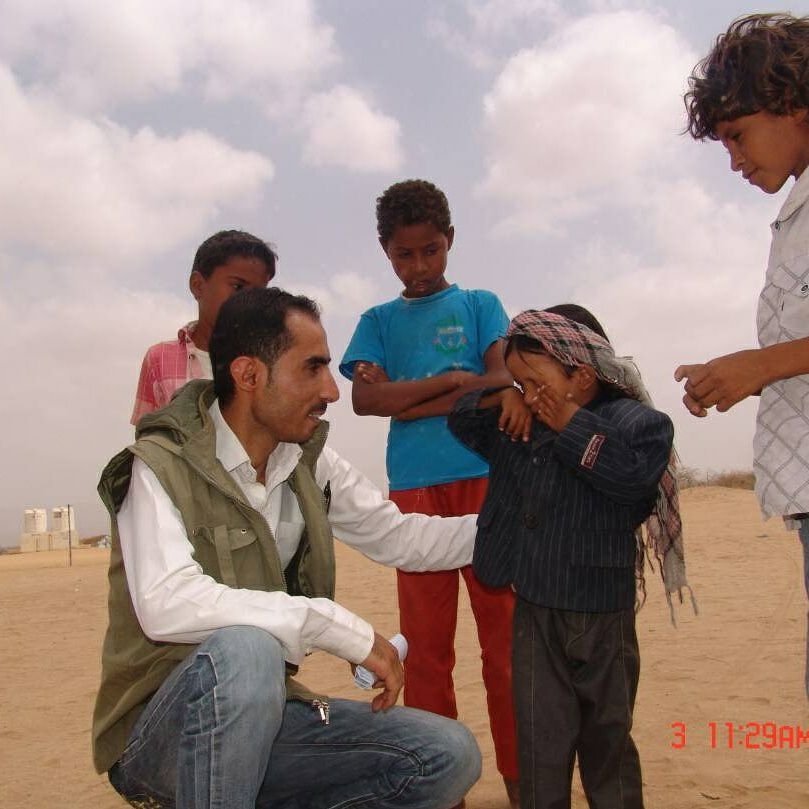
To see a young boy, no more than seven or eight, crying because of the war, is something we will never get accustomed to.
Qasim Ali Al-Shawea – in the picture – of Your Abilities Yemeni NGOمنظمة قدراتك للتنمية your.abilities.org ) writes:

”Every day I meet a child, family, displaced people during my work with my team and I have a close look at people’s unbearable conditions, how they try to stay safe, alive in such a humanitarian disaster. 
I see children sleeping at night with empty stomachs, after having fought hunger for several days.
I meet many families who have fled their homes to live hopeless, homeless in displacement camps; I am seeing a daily nightmare, a tragedy I have never seen…ever, in my life.
How not to mention the Cholera outbreak which is decimating lives while hospitals are full with patients. 
What is happening in Yemen is really inhuman, illegal and unfair. We are human beings and have human hearts, the world shouldn’t keep ignoring the children and women’s suffering. Every child deserves to live a better life.”

I asked Qasim why was the young boy shedding so helplessly and he replied:
He told me that he and his family used to have a better life.  That was before bombs fell on their home. He was crying because his brother was killed there, at home, under a missile. Now they are living in a tent in a displacement camp. They have nothing to eat, monsoon rains enter the only abode they have. He wants clothes… he really asked me a lot: new clothes, toys, a chance to study. He is a clever child. I felt so sad for him and their life, the hard conditions they must cope with. Heartbreaking, really.”

The picture of a child, dressed like a man in the making, with a jacket which most likely will be worn until it fades to a shadow of a garment, crying helplessly cannot be the emblem of childhood. Not in 2017.
Yemen has been under air strikes, blocked by a siege, crippled by cholera and famine for over eight hundred and sixty days. A number so heavy it seems too long even to write. Impossibly long for a child whose home and past have been buried under a missile.

A Love in the Middle East

No one would dream of living where they live.
Unless forced to.
His country
is a bulletin of war
coming from the borders,
originating within.
Hers,
a divided land,
stitched together by wars and treaties.
Proud countries.
Untamed.
Hysterically feared by the world.

He tells her: Write about our love, my love.
She promises she will.

They have their own way of coping with reality,
of preserving their love.
They pass by the respective daily checkpoints
each one knowing
that today one could be fake,
controlled by the wrong faction,
unfriendly with friendly fire.
Perhaps their last checkpoint.
They both refuse
political or religious discussions.
They dream big and endlessly.
So often together.

He tells her: Write about our love, my love.
She promises she will.

They talk about their jobs,
the daily insignificances.
It paints normality
where nothing is normal.
They dream big and endlessly.
So often together.

She knows
he is not safe.
He fears
she is nothing more than a target
to reach the headline news.

Extensively,
they both refuse
to follow the news.
He knows where she is at 11 am
She knew he was sleeping this morning.

He tells her: Write about our love, my love.
She promises she will.

He called her.
He went to the Capital this morning.
And no, he kept it to himself.
The checkpoints
the bombs
the demonstrations
He spared her all these thoughts
“I did not tell you, my love”, he says.
She knows the reasons why

He tells her: Write about our love, my love.
She just did.

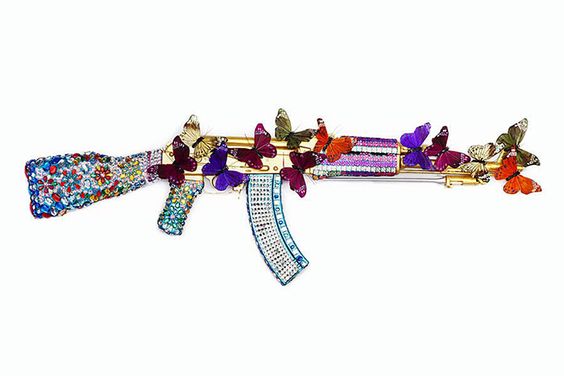
Picture: artwork of Laila Shawa