The purest words. Ever

It was the richest, most avant-garde, secular country of the entire Middle East. One of the smallest nations of the world held the hearts of people from the region and beyond. Its cosmopolitan heyday lasted roughly from the mid-50s to 1975.

It was the emblem of liberalism, of how – at least on the surface – differences can unite a coexisting variegated population: Muslims Sunni and Muslim Shi’ite, Christians.
All together in that tiny land of mountains and Mediterranean Sea, that handkerchief on planet earth that was so unique it allowed you to go skiing in the morning and swimming in the afternoon. Everything seemed easy, reachable and possible in Lebanon, starting from happiness.

On the surface, it mattered little if it was France, the colonizing power up to 1943, who drew Lebanon’s borders, if starting from then the country was ruled by a sectarian elite, if factions of self-interest always prevailed ahead of state and nation and if the idea of a nation was still embryonic.

The intentions were good: at the founding of Lebanon, under the National Pact, it was agreed the President had to be a Christian Maronite, the Prime Minister a Sunni, the Speaker of Parliament a Shi’ite Muslim. The quota of democracy.

In 1952 Lebanese women gained the right to vote and, the year after, Parliament drafted one of the first anti-corruption laws of its kind. Lebanon was ahead.

Tourism boomed, both from the Arab World and from afar. The jet-set had chosen Beirut to holiday and be seen, jet-ski and indulge.
Brigitte Bardot, Peter O’ Toole, ElizabethTaylor and Richard Burton, Omar Shariff, King Farouk of Egypt were habitués of the iconic St. George’s Hotel; Casino du Liban hosted Miss Europe beauty pageant (1964) and was the stage where Duke Ellington and Jacques Brel performed.
Postcards from Lebanon made everyone dream.

Middle Eastern companies were transferring their headquarters to Lebanon, Beirut was the financial and trade centre of the entire region, its harbor known for hosting cruise liners (see the Queen Elizabeth II) while the American University was the debating society of the new thinkers.

That Mediterranean appeal with the Near Orient flare were the perfect alchemy. Yet, it was glamorous, but there was no national unity, still.

It was affluent, but not for everyone: poverty, out of Beirut, was spread. It was fashionable and avant-garde, but beneath the surface discontent was palpable, deriving from sectarian politics.

Lebanon – like no other country in the world – was continuing to bear the shockwave of the creation of the State of Israel (1948) which had sent 100,000 Palestinian refugees over the border.

It was a foretold catastrophe and it started in 1975.

The war, a prolonged agony, lasted up to 1990. Over fifteen years of numerous internal and external contenders, alliances and frequent reversals of alliances, of massacres. Endless. It became one of the most difficult conflicts to report and analyze, fought from building to building, door to door, window to window, breath to breath. It was the war of the neighbourhoods, streets, barricades and barrage of atrocities and explosive devices. It was the war that generated subconflicts, claimed the life of at least 120,000 people and swallowed 17,000 through forced disappearances.

It was chaos, with Syria dreaming to place Lebanon under the project of a ‘Greater Syria’ and Israel intending to oppose the PLO (Palestinian Liberation Front) militiamen creating a security zone under their control.

At the root, though, it was pain. Immeasurable pain, still felt today.

One night, I happened to watch some footage from the War of the Camps, a sub-conflict within the 1984–89 phase of the Lebanese civil war in which Palestinian refugee camps were besieged.
Of all the horror I swallowed, I could not refrain hiccups and tears when the images moved to a wounded child, on a ‘hospital’ bed.
There was nothing human in that scene.
A grown up was telling the young boy to be strong and resist.
The child asked how could he resist and the grownup replied “Pray, pray to God”
And so the boy did.
Laying in his trauma, his tattered bloodied clothes, the boy uttered:
“Dear God, protect my father. Dear God, protect my mother”.

Amid an ocean of obscenities, a tiny clean island.
Amid soul-corrupting hate and inhumanity, a quiet utterance of human soul.
This is surely a purity that should make all hearts, human and godly, weep.
The machines of hate are never silenced.
But one candle then, and many like it now, flicker their fragile human light against the blackest of blacks.
We can only trust and hope, that hope is never lost.

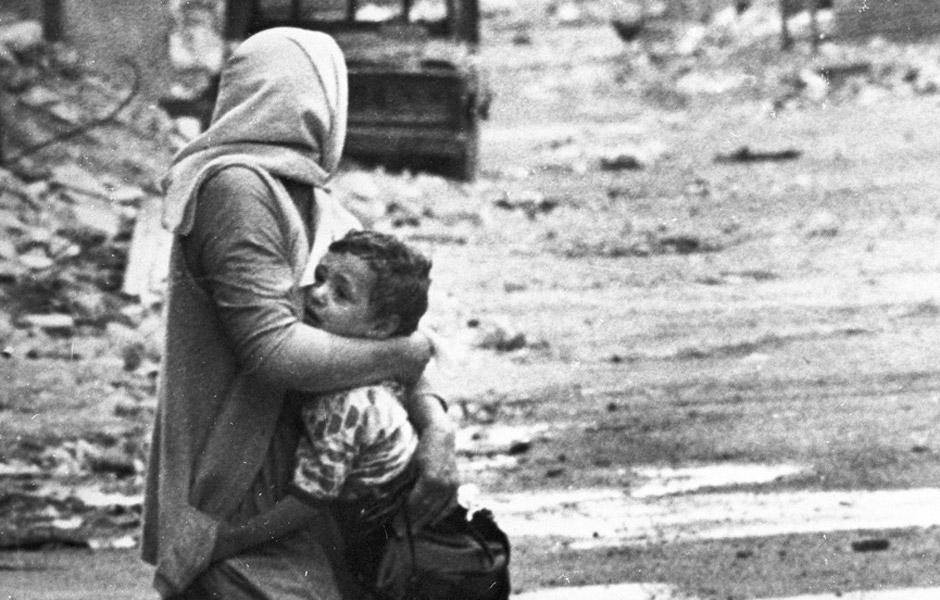
photo: A Palestinian refugee and her child caught in sniper fire during the War of Camps. Author: unknown
Afghanistan, Beyond the Battles

Mujahideen, the Taliban, North American invasion of 2001, the struggle for democracy (whose democracy? Which democracy?), through the eyes, scars on skin and words of the actors on the ground.

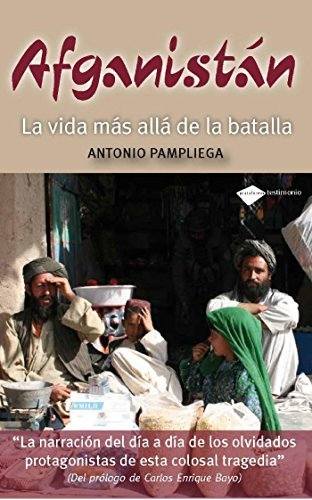
Antonio Pampliega‘s book Afganistan Mas Allá de La Batalla (Testimonio) had the intent to humanize the inhumanity of war and, specifically, the endless state of wars in Afghanistan, a country so torn that newsrooms can no longer handle truth.
Nobody cares any longer.

Nobody cared and cares of Sayid, barely four months old who died quietly, in a hospital bed where there are no medicines, where machinery donated by NGOs could not benefit from maintenance or the luxury of top-notch spare parts.
Nobody wants to care.
Nobody has the time to notice.
Sayid was a victim of statistics, they say. Just one more number in a long list that measures in decades.
In 2010, when the book was written, of every ten children born, more than half died before reaching the age of five.
We know it did not get any better. Perhaps never, in our lifetime.

I think of Pampliega’s encounter with the people involved in the renaissance of a bookstore, a cinema, a team of girls playing football, a tireless NGO, the victims turnt into angels of prosthetics and rehabilitation in a hospital and all those hopes and dreams of a dignified life.

I bow to his tribute to the figure of fixers, especially his fixer in Afghanistan, without whose help this book would have never been possible and without whose dedication most of the articles and correspondences around the world would never come to life. If we know anything about a difficult country, we owe it to fixers, not governments.

The people who become heroic in Pampliega’s Testimonio are ordinary people who simply try to do the right thing.
Who choose to stay human and be their better selves whatever context they navigate.

The book made me think of someone I knew, a young Afghan called Mansoor.
People like Mansoor made sense of this world.
He believed in education, he believed in egalitarianism in its purest sense.
He loved children.
When he started working for Save the Children, he followed a special and essential project: bringing clean and safe water to remote villages of Uruzgan province, Afghanistan.
His actions meant everything to so many.
In 2015, Mansoor – just 25 – was kidnapped with four colleagues.
After a month of negotiations, the captors decided to proceed with the slaughter of the five young men.
Along with Mansoor, the captors took the life of Rafiullah Salihzai, 27, Naqibullah Afkar, 29, Mohammad Haroon, 27 and Mohammad Naeem, 24.
All but Mansoor were married and, together, they left 12 children behind.
Mansoor is gone, his killers most likely are still alive.
Antonio Pampliega would have loved him.

They say that when Allah made the rest of the world, He saw that there was left a heap of rubbish, fragments, pieces and remains that did not fit anywhere else. After gathering them, he threw them into the ground and thus created Afghanistan.
Make some sense of it

Taeko’s children of Yemen

A couple of years ago I discovered Taeko Kunishima‘s music. I played it on loop.
Taeko is a pianist, a composer a former child prodigy who started playing music at the age of seven, moved by the pillars of the classics – Beethoven and Mozart – and the transcendence of the notes.
Until she accidentally discovered Miles Davis on the radio, forever changing her trajectory.

Now Taeko plays her own jazz, a constant, perpetual ensemble of places and people, sounds and colours.
Taeko has travelled extensively in her life and her music does take you places, her music does make you feel: a borderless world where water, fire, wind, earth, people skirt and fuse into one another.
Playing Taeko, I often have a vision of sea rocks being splashed by dark waves on a rainy day and seaweed dancing just there: between the stone and water element.
Her tunes are intense and elegiac, light and airy. Taeko’s music is impalpable and real.

At the time, when I commenced playing her music, I was very much involved in a project on love in its broadest sense and tried my luck dropping Taeko a line, asking if she could talk to me about love. Perhaps, I suggested, love for her music, her native Japan or places she’d been to. Obviously, love for her art. Anything that moved her and meant love to her. I was interested in her talented soul and her relationship with love.

Taeko never questioned once who I was, if I had credentials. She knew my name, had my contact details, knew I cared about peace and human rights.
Candidly, out of the blue, she said: I can write music about love and Yemen.

I halted the project on love as life and all its unpredictable hiccups got in the way. Taeko, instead, kept her word.
One of my favourite artists did not turn her back on the obscenity of war.

She loved through music composing ‘Love and Peace‘ and the poem you hear is read by Jeremy Hawkins: a reflection on the inarticulate nature of war. Dedicated to the children living in Yemen.
Nothing less.

”Through the dust comes the sight of birds flying high
What do they know?
What do they think they can really see?
A call from a window.
A noise in a street.
But far echoes.
Through the roof comes the sight of flight’s lost might
What do they know?
How can they think none can really see?
A fall from a window.
A noise on a street.
Just far echoes.
Only dreaming of daylight, now sleeping, lives don’t torture them.
Now nearly starved, eating all apart from hope.
Through the loss comes a fight to make things right
All say they know.
None to say that death’s not like dreams
No longer a window
No longer a street
Just war’s echoes”


photo

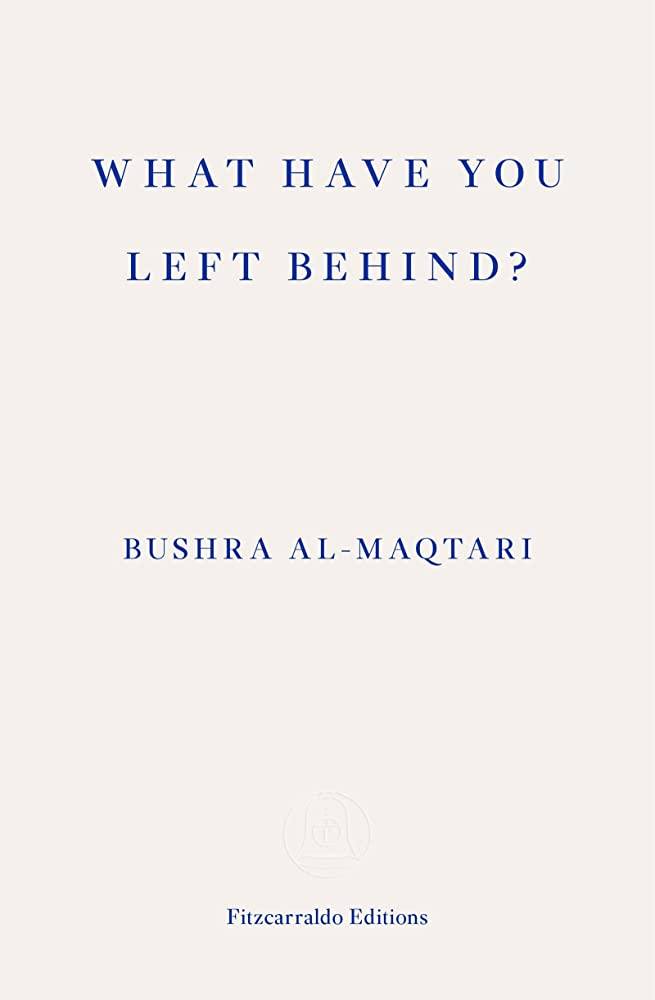
A piercing book: ‘What Have You Left Behind’ by Bushra Al Maqtari

Most likely, there will never be a more perfect, dramatic, piercing book on the war in Yemen than What Have You Left Behind (Fitzcarraldo Editions) written by Yemeni researcher, writer, novelist Bushra Al Maqtari.

The introduction – painful yet without pity and hyperbolism – is a slap in the face: all the lies naively told in order not to accept that war was – with a perverse logic – inevitable, the signals no one wanted to pay attention to, the country abandoned by those who knew what was coming, a nation militarized to the limit and then attacked by the Coalition forces in 2015.

Bushra Al Maqtari’s Yemen (the book covers the period 2015-2017) is a country under siege, blockade (of cities and nation), run by the economy of the black market, the war profiteers (local and diasporic), where people can die of diseases, hunger, silence, homeless, father-and-mother-less, a country of orphans and survivors with no answers, no balm to their pain.
A country where the basics – water, electricity, food – are a vestige of the past.

It is a Yemen of imprisonment, torture, forced disappearances, air raids and shellings. The shelling from Yemenis to Yemenis, just of different factions.

Bushra Al Maqtari – who has more courage than a battalion of millions – interviewed over 400 people traveling at her own peril, listened to their stories, gathered some of their testimonies in a book compiled by those who have no one listen to their cry.

Children died while playing in the street, families were buried alive under missiles targeting their homes, bodies were never fully recovered (or recognised or put together one last time), fishing boats and huts targeted by Apache helicopters, even a boat from Somalia carrying fleeing Africans was attacked.
And aid organisations absent. Totally absent. Nonresponsive.
You read of people living in shops, in converted schools or skeletons of former government buildings. On the street.
Mutilated families and bodies of Taiz, Aden, Sanaa, Hodeydah, of villages. Areas difficult to place on the map, though the geography of war targets anyone with the most accurate precision.

What Have You Left Behind is a haunting read with no answers, no cure, no explanation, where the culprits come from all sides and it makes no difference: war crimes are war crimes. There is no such thing as fair and just killing or understandable, justifiable killing.
It is a book of victims whose pain runs so deep it alters humanity’s DNA.

A must read.

—————————–

Bushra al-Maqtari (بشرى المقطري; born 1979) is a Yemeni writer and activist who came to prominence as an anti-government protest leader in her hometown of Taiz during the 2011 Yemeni Revolution.

Children’s Drawings from Yemen

Last February Melissa McCaig Wells, along with Curators Victoria Latysheva, Charlotte Hamson presented in New York TRUMPOMANIA, an international exhibition surrounding the topic of Donald Trump and the Republican administration in the US.
The exhibition ran in NYC March 1-5, in correlation with The Armory Show and Armory Arts Week, to a worldwide audience.
TRUMPOMANIA featured one artist from over thirty countries, each exhibiting one work illustrating their interpretation of the election of Trump creating a dialogue about what this presidency means to artists around the world and their illustration on how this will affect the future of all nations.

Melissa pushed the boundaries further and opened the doors of the exhibition also to the children of Yemen, affected by – at the time – 2 years of endless war (aggression by US-backed/Saudi led Coalition). Now it’s 970 days of war.
Not only Trump’s ban on Muslim countries included Yemen, but America’s inconsiderate arms sales to Saudi Arabia (110 billion USD) are part of the maiming and killing of thousands of children of Yemen.
Drone strikes have seen a sharp rise (over 100 in 2017 by the Trump administration) and without US logistical, technical (refueling of Coalition’s aircrafts bombing Yemen) and intelligence guiding, the Coalition would not have been able to cause such a level of destruction.

The situation on the ground between February and today has worsened beyond belief: the country is under lockdown, no aid enters while 20 million of Yemenis are dependent on aid; 50.000 children are expected to die by the end of the year of famine, curable diseases, cholera, diphtheria, meningitis or just because too weak to continue living.
Three cities (Saada, Hodeidah, Taiz) have no more access to safe water as the fuel is not entering the country and Sanaa, the Capital, will be next.
Cholera outbreak – of biblical proportions – will most likely affect 1 million people by the end of the new year, with over 2000 casualties officially recorded.

For TRUMPOMANIA, last January and February, we collected drawings from Yemeni children (who happen to be the only reason behind everything we have been doing for the past 970 days day) asking them if there was something they wanted to say, to add beyond the headlines or lack of media coverage.
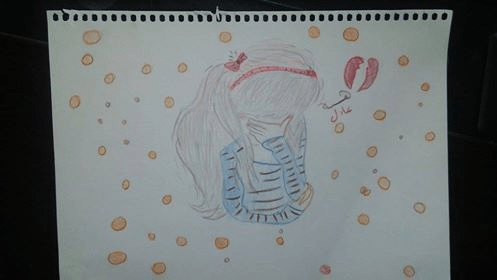
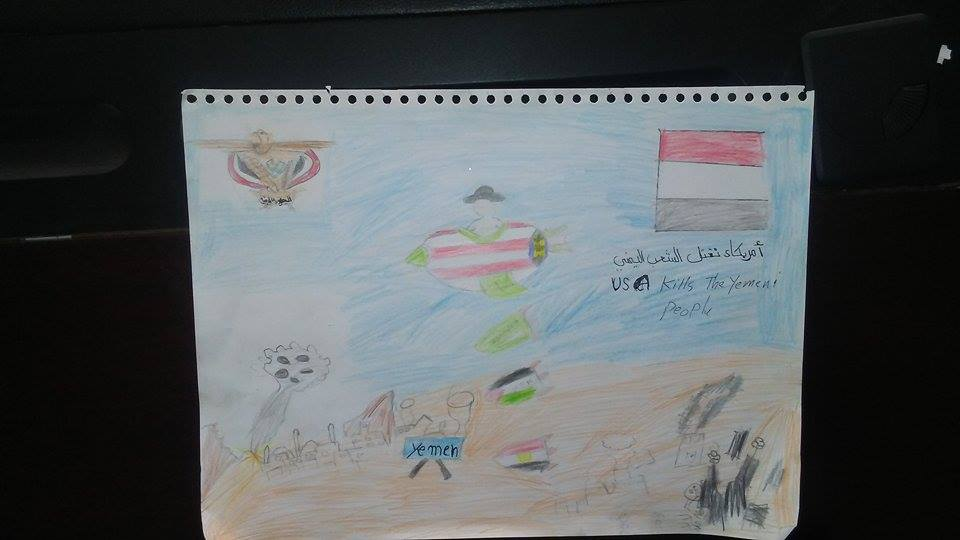
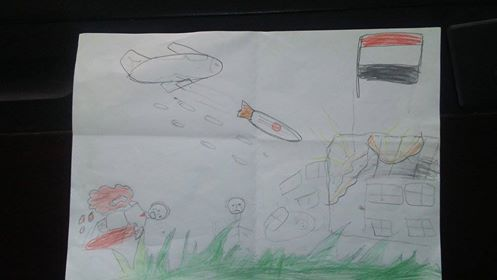
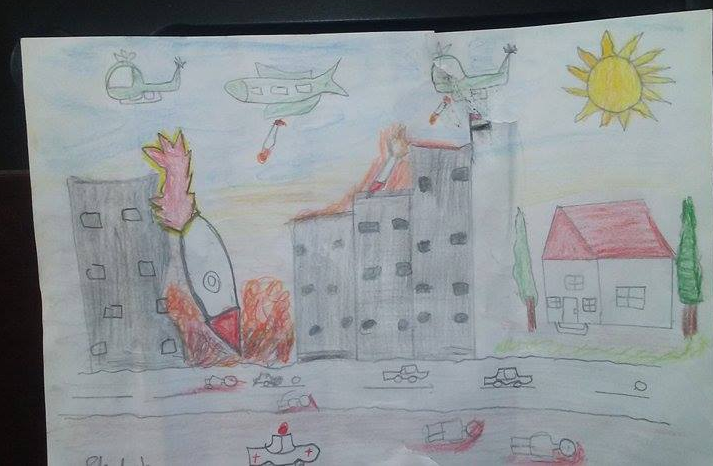
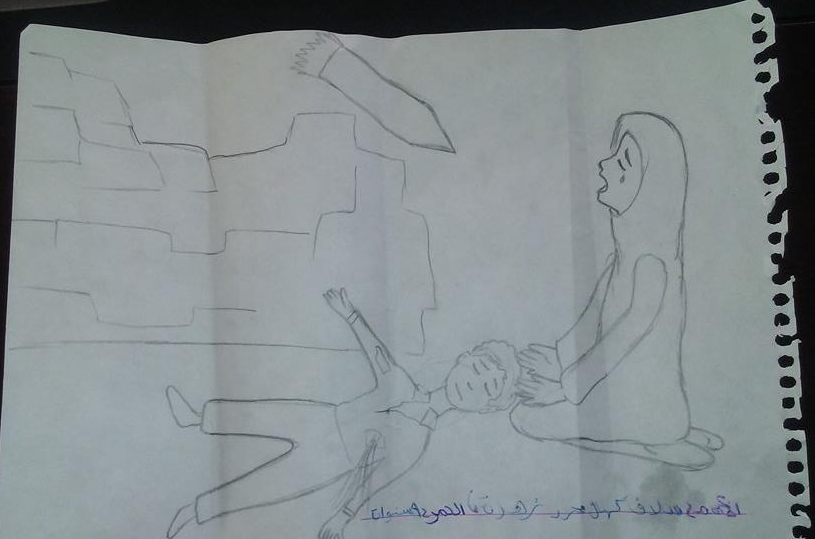
Children spoke their language through drawings and scribblings and the results were appalling. Chronicles of daily scenes of massacres and warplanes, destruction, fire and blood.
The drawings here below (just a part of a large collection) were gathered for TRUMPOMANIA by two registered Yemeni NGOs: Human Needs Develooment – HND and Your Abilities Organization and, on World Children Day we leave it here. As a ‘j’accuse‘ for us all.


Omar Mohammed – 10 years old


1
Amasy Bushier Al-kenay Age: 11 Depicting the bombing of Faj Attan where an illegal bomb was dropped killing/injuring over 500


70
Alaa Mohiy Sharfaldeen


2
Name: Amar Jamal Hamdy, Age – 12 USA kills The Yemeni people

3
Hanan Alsdah, Age: 10 Describes buildings before and after the bombs

44
Heba Adel, Age: 12 – A girl cries, fearing bombs and warplanes sound

555
Roaa’ Dariss, Age 10 – A missile targeted a home and killed the family, and injured were seen out of the home

6666.png
Abdullah Zuhrah, Age 12 – The sky watching Yemen and crying with blood

o
Asra Adel, Age: 10 Destruction and bodies in the streets

77
Shihab Majdi, Age 9 – The missile took the house


g
Maddlaf Kamal, Age 9 – A mother crying for her kid killed by Saudis’ bomb


A young man in the making in times of war

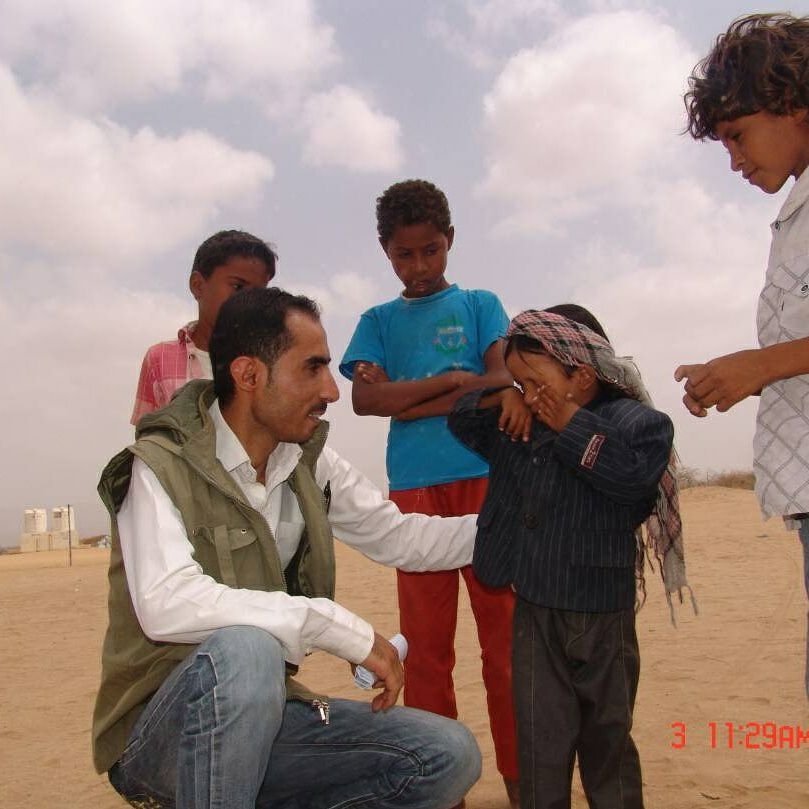
To see a young boy, no more than seven or eight, crying because of the war, is something we will never get accustomed to.
Qasim Ali Al-Shawea – in the picture – of Your Abilities Yemeni NGOمنظمة قدراتك للتنمية your.abilities.org ) writes:

”Every day I meet a child, family, displaced people during my work with my team and I have a close look at people’s unbearable conditions, how they try to stay safe, alive in such a humanitarian disaster. 
I see children sleeping at night with empty stomachs, after having fought hunger for several days.
I meet many families who have fled their homes to live hopeless, homeless in displacement camps; I am seeing a daily nightmare, a tragedy I have never seen…ever, in my life.
How not to mention the Cholera outbreak which is decimating lives while hospitals are full with patients. 
What is happening in Yemen is really inhuman, illegal and unfair. We are human beings and have human hearts, the world shouldn’t keep ignoring the children and women’s suffering. Every child deserves to live a better life.”

I asked Qasim why was the young boy shedding so helplessly and he replied:
He told me that he and his family used to have a better life.  That was before bombs fell on their home. He was crying because his brother was killed there, at home, under a missile. Now they are living in a tent in a displacement camp. They have nothing to eat, monsoon rains enter the only abode they have. He wants clothes… he really asked me a lot: new clothes, toys, a chance to study. He is a clever child. I felt so sad for him and their life, the hard conditions they must cope with. Heartbreaking, really.”

The picture of a child, dressed like a man in the making, with a jacket which most likely will be worn until it fades to a shadow of a garment, crying helplessly cannot be the emblem of childhood. Not in 2017.
Yemen has been under air strikes, blocked by a siege, crippled by cholera and famine for over eight hundred and sixty days. A number so heavy it seems too long even to write. Impossibly long for a child whose home and past have been buried under a missile.

Landmines and wheelchairs in Sanaá

There is one basic fact difficult to divulge and get through: prior to the aggression on Yemen by Saudi Arabia and coalition of mercenaries with the silent approval and support of US Intelligence, situation in Yemen was already unbearably difficult.
What is known as the current Yemen had been a battle field of almost 20 conflicts, some overlapping, others extremely long, few still continuing.
A General I briefly met in 2011 prior to the revolution which ousted President Ali Abdullah Saleh told me his job was to ´mine-clear certain areas of Yemen´. He had been working on it since 1992, almost 20 years.

A report by OCHA on children tormented by landmines dated July 2013 states: ´Landmines have plagued the people of Yemen for decades. In the 1960s, they were laid along the border that separated the north and south of the country, and they were a tragic feature of tensions throughout the 1990s.
More recently, Government and militant forces have been accused of using landmines between 2004 and 2011 in conflicts in Sa’ada Governorate in the north and Abyan Governorate in the south. In 2011 and 2012, antipersonnel mines were reportedly also used in and around Sana’a, and in March 2012, Yemen’s Ministry of Defense reported landmine casualties in Hajjah Governorate on the country’s north-west coast.
The number of mine-related civilian casualties climbed significantly in the third quarter of 2012, following an announcement by the military in June that they had ousted militants from Abyan. As a result, thousands of people who had fled the conflict returned home to areas that had been heavily mined.´

In the same report:  ´The Yemen Executive Mine Action Centre (YEMAC) is doing much of this work with the support of the UN Development Progamme […]. Between July 2011 and February 2012, YEMAC and its partners destroyed almost 290,000 explosive remnants of war, including almost 90,000 anti-personnel mines as well as anti-vehicle mines, shells and improvised explosive devices´.

We are talking about thousands of bombs, with no exaggeration. This, prior to the war on Yemen in 2015.
Let it sink in that what has come after will require decades, if not a century, to assess, digest and clear.

Every personal memory now makes reference to prior and during the war (during because the war is still raging on Yemen).
There is one scene I have clear in mind. It belongs to the end of 2014.
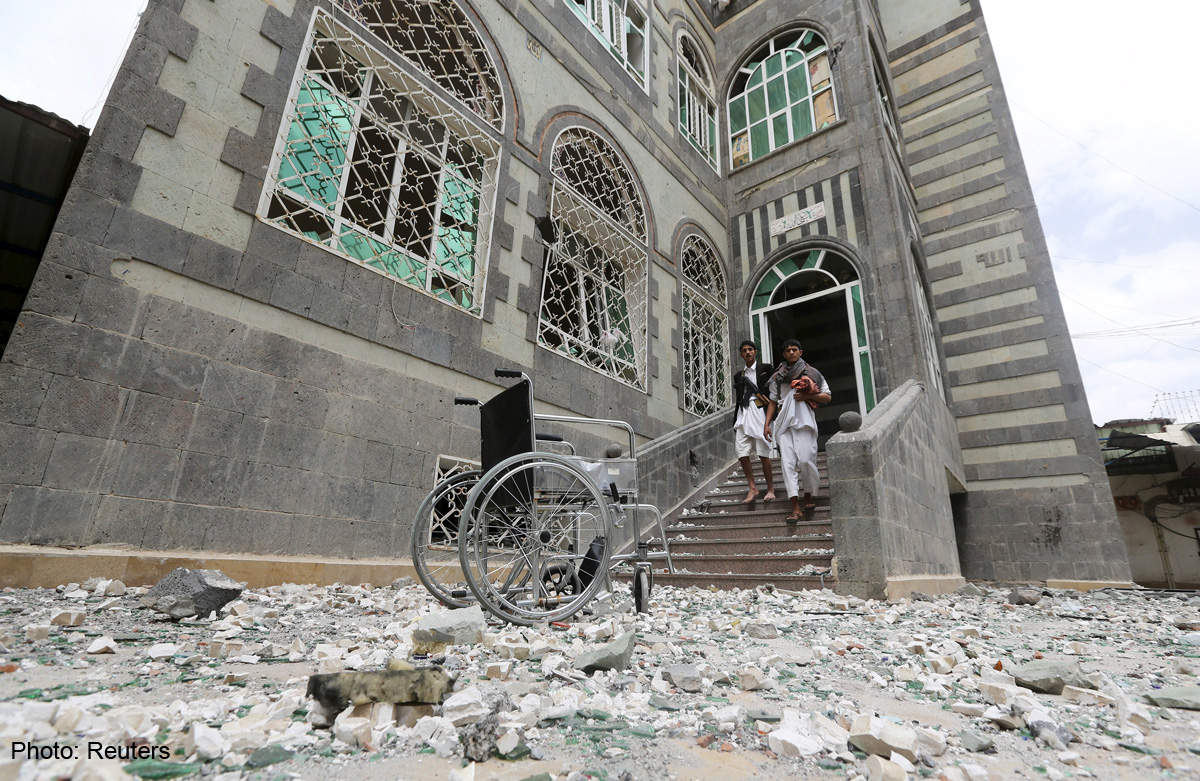
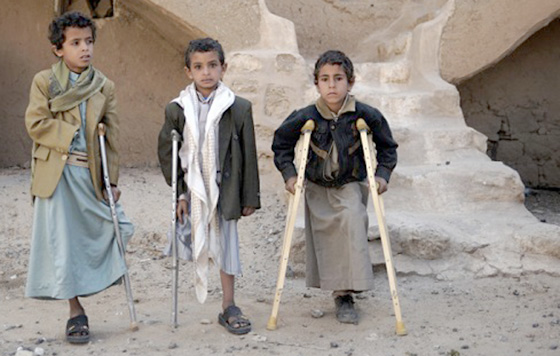
As part of a national effort to reach those less fortunate, the Yemeni government had bought wheelchairs, crutches, walkers, prostethics and cranes for the disabled and was doing medical checkups in Sanaá. Those who could not be helped in Yemen were going to be flown either to India or Egypt for medical treatment.
The maimed were all from prior wars. Sanaá had been invaded by buses coming from almost all the governorates.
In our hotel we were hosting  people coming from the villages (mainly  from Hajjah and Amran). Some could barely walk, others were crawling. Limbs were missing in children and adults alike (mines do not stop exploding simply because a war is declared over).
In the lobby, in our offices, we had mountains of folded, shining, new wheelchairs ready to be distributed.
It was hectic, with loud voices.
Until I heard no more: before my eyes  the scene of mothers  taking pictures of the family united in front of the new gift, the wheel chair. They were smiling, they were joyous.
Who, in Europe, would take a selfie with a wheelchair?
I had to rush to the back of the  office crying and suffocating in tears. I was strangling myself with tears. I had just realised some families required 2, 3, 4 wheelchairs just for their children.

These same people are being bombed, every day, in Yemen. With an abundance of infamous, internationally banned cluster bombs.
Alhmdulillah, Yemenis say.

Yemeni children take death as a part of life

No food, no medical aid and medicines allowed to enter Yemen thanks to the Saudi-led land-air-sea siege on Yemen. A siege which has entered its second year, just like the war.
What was meant to be a brief military campaign carried out mainly by airstrikes, has turnt into a catastrophe which is paving the way to a genocide.

Yemeni children wonder what have they done wrong to the King of Saudi Arabia and how they, just children, can pose a threat to the Kingdom´s security.
Many children have starved to death, 320.000 are food insecure and malnourished and many children have already died of illnesses. Hard to get any more horrific than this in a country where, since memorable times, 58% of the population lives with less than 2$ per day.
Yemen is rich in culture, history, scenery, landscapes, traditions but when it comes to money, the vast majority of its inhabitants barely reach the end of the day while next meal remains uncertain.

According to the synthesis of the latest UNICEF´s report on the impact of the war on Yemeni children on NPR´s The Deadly Consequences To Children Of Yemen’s War :

At least 6 is the number of children killed or maimed daily.
934 the number of children killed during the past year as a result of “grave violations.” One thousand three hundred fifty-six were injured. 
10,000 approximate number of children under five years old who died over the past year “from preventable diseases as a result of the decline in key health services such as immunization against vaccine preventable diseases and the treatment of diarrhoea and pneumonia.”
848 U.Ndocumented cases of child recruitment for the fighting.
51 U.N.documented cases of attacks on education facilities.
At least 6 million children living in poverty
320,000 children facing severe malnutrition
10.2 million  children at risk of “going without safe drinking water and sanitation.”
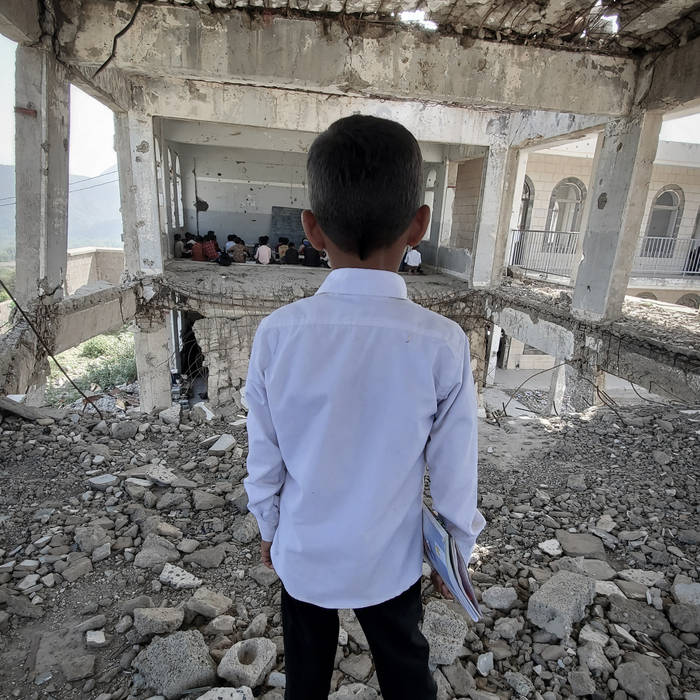
More than 1.8 million number of children “forced out of school” because of the violence.
1,600 schools that are closed because of the fighting.

To keep on bombing and wage war on the country, with this reality on the ground, implies a will to destroy Yemen. Thoroughly.
Yemenis may be strong and resilient. They accept anything as everything is a will of God, but the country collapsed immediately during the first month of bombardments.
Numbers and statistics are appalling.

11223848_1003979859655044_7340796197623315826_n
In Sanaá, the story of  Ahmed is just emblematic of the situation inside Yemen.
He is thirteen years old. He has experienced, already, being under thousands of bombs since the war on his country erupted. He has experienced enough fear, sadness and desperation since March 26 of last year.
But Ahmed is not like any other kid. He has hepatitis and no medicine in sight. Ahmed has grown fast and accepts his fate. There are no medicines in the few operating and still standing hospitals in Yemen (95% of hospitals have either been bombed or had to shut down due to lack of gasoline, water and medicines) and clock is ticking against him.
Absurd as it seems, there is no way of helping him.
Most likely Ahmed will leave us and the world will never know that there was a kid called Ahmed, Yemeni, and had dreams like any other kid and that our silence against this genocide inflicted on the Yemeni population helped him on his last journey.
Someone will have to explain all this to his parents.
Ahmed, on the contrary, accepts his fate. The afterlife cannot be worse than this last year.

12923212_797471797053229_8466540354220626259_n
Abdullah
and Ali Qassim are two Yemeni brothers, both with cancer.
Luckily, they managed to leave Yemen and are currently being treated in Jordan.
Today, Friday, the first Friday of the month of Rajab which marks the anniversary of Yemenis entering Islam, some  called on the nation to pray for them.
Abdullah and Ali are fighting a double battle: beat the cancer and, once they return to Yemen, survive the war.
They accept whatever comes and never complain.

And then there is Ammal Awaddh. Her words would break any soul.
Take a deep breath, read and look at those eyes.
You may cry, afterwards

‘My father bought me these new earrings for Eid.

I convinced him to let me wear them today because no one knows if I will still be alive when Eid comes’
(Ammal Awaddh, 5 years old)

12932665_1001289849924045_417004909850438985_n

With Qassim Alshawee from Sanaá