Incendies: relevant as ever

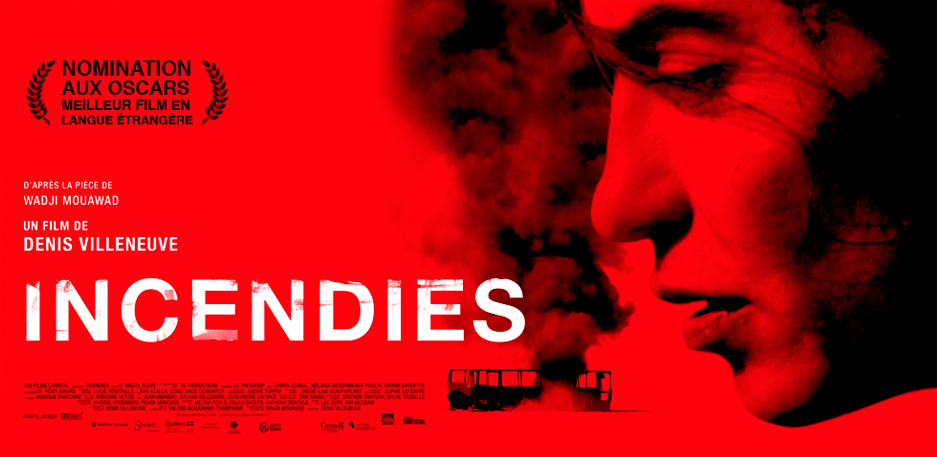
INCENDIES is a punch in the heart. It petrifies you as it speaks the language of any given war with the addendum, that additional element, that it is a sectarian war which turns into your blood system as a reminiscence of the Lebanese civil war (1975-1990, 150.000 lives lost).

It is one of the strongest films I have ever watched.

Simon and Jeanne are twins of Arab origin living in Canada where they must visit a notary to hear their mother’s will.
Out of the blue, they discover they have a brother and that their father is still alive.
To put things in order, deal with their mother’s last wishes and continue with their life, they have to travel to an unnamed Middle Eastern country that is recovering from years of sectarian war.
While painfully discovering their mother’s past, their future will never be the same.

Adapted from Wajdi Mouawad’s 2003 play (Mouawad fled Lebanon when he was eight), Incendies overflows with atrocities, yet it leaves an indelible impression as no one plays the victim: wars happen and we all act accordingly, whether with moral nobility or imbued with wickedness.

Directed by Denis Villeneuve – Canada, France, 2010, the film convinced me to say, again, that I highly dedicate the narrative to all those who dream of revolutions and of a fictionary ‘last war that will restore stability and world order’. Buffoons.

Notturno, the evanescence of borders

The borders between Syria, Lebanon, Iraq and Kurdistan in a film that took three years to shoot.

Borders are a sensitive matter, almost everywhere.
In the Middle East, Europe – at the fall of the Ottoman Empire, imposed new ones, often drawn arbitrarily, carelessly ignoring the region’s ethnic, religious, and linguistic diversity. Ignoring its past. Mining the future.
What followed have been incessant decades of wars and revolutions, coups and counter-coups, dictatorships, feeble monarchs, shaky republics and horrific ground for ISIS all-round fuckery.

Borders can be volatile and represent the difference between salvation and aggression, freedom and war, dreams and death. Borders contain the true victims of history: people trying to get by with their daily lives.
Borders are guarded by men in the middle of nowhere, at times defending God knows who by God knows what.

Italian director Gianfranco Rosi in his NOTTURNO filmed and followed the borders created by the Islamic state: borders which represent the divisions, the invisible stratifications that history has left. And the betrayal of humanity.

In a film where I constantly tested myself to understand where I was, trying to recognise the architecture or the fauna, the hijab and minarets, license plates and history through the walls, I was left in awe in front of the most sublime narrative painted through Rosi’s handheld video camera.

Notturno is a cinematic work of art that stabs your heart when Yazidi children recount their life under ISIS and yet never fails to show the impalpable beauty of the rest. And by ‘rest’ I mean everything else: human relations, traditions, nature and colours.

The film closes with the notes of Saja Al-Maghasba , Mawtini: والحـياةُ والنـجاةُ والهـناءُ والرجـاءُ (life, salvation, contentment and hope), enough to shed all of humanity’s tears.

I watched this masterpiece twice, and it does not leave me.