A couple of years ago I discovered Taeko Kunishima‘s music. I played it on loop.
Taeko is a pianist, a composer a former child prodigy who started playing music at the age of seven, moved by the pillars of the classics – Beethoven and Mozart – and the transcendence of the notes.
Until she accidentally discovered Miles Davis on the radio, forever changing her trajectory.
Now Taeko plays her own jazz, a constant, perpetual ensemble of places and people, sounds and colours.
Taeko has travelled extensively in her life and her music does take you places, her music does make you feel: a borderless world where water, fire, wind, earth, people skirt and fuse into one another.
Playing Taeko, I often have a vision of sea rocks being splashed by dark waves on a rainy day and seaweed dancing just there: between the stone and water element.
Her tunes are intense and elegiac, light and airy. Taeko’s music is impalpable and real.
At the time, when I commenced playing her music, I was very much involved in a project on love in its broadest sense and tried my luck dropping Taeko a line, asking if she could talk to me about love. Perhaps, I suggested, love for her music, her native Japan or places she’d been to. Obviously, love for her art. Anything that moved her and meant love to her. I was interested in her talented soul and her relationship with love.
Taeko never questioned once who I was, if I had credentials. She knew my name, had my contact details, knew I cared about peace and human rights.
Candidly, out of the blue, she said: I can write music about love and Yemen.
I halted the project on love as life and all its unpredictable hiccups got in the way. Taeko, instead, kept her word.
One of my favourite artists did not turn her back on the obscenity of war.
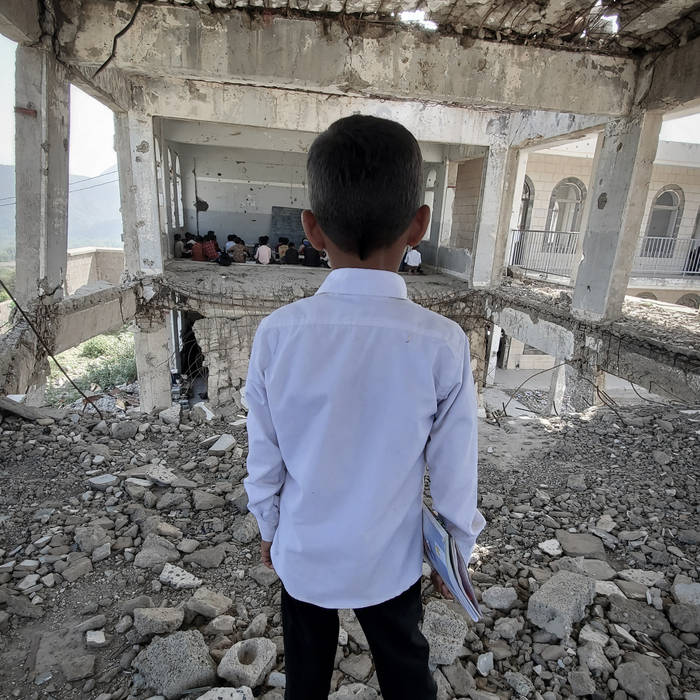
She loved through music composing ‘Love and Peace‘ and the poem you hear is read by Jeremy Hawkins: a reflection on the inarticulate nature of war. Dedicated to the children living in Yemen.
Nothing less.
”Through the dust comes the sight of birds flying high
What do they know?
What do they think they can really see?
A call from a window.
A noise in a street.
But far echoes.
Through the roof comes the sight of flight’s lost might
What do they know?
How can they think none can really see?
A fall from a window.
A noise on a street.
Just far echoes.
Only dreaming of daylight, now sleeping, lives don’t torture them.
Now nearly starved, eating all apart from hope.
Through the loss comes a fight to make things right
All say they know.
None to say that death’s not like dreams
No longer a window
No longer a street
Just war’s echoes”
photo
 the talking of the soul